

 France
 Espagnol
Helpful Information for your Vietnam Tours
Vietnam
Vietnam is not an ideal destination for those who looking for something glamorous. But if one would want to get out of his comfort zone to infiltrate himself to whole new experience about life in general and the discovery of a new culture, with a change of scenery, Vietnam tours are the ideal choice.
TERRITORY
Being a part of the Indochinese peninsula countries, Vietnam has simultaneously opened to Indian and Buddhist influences, on the one hand, and to that of Confucian and Chinese world, on the other hand. The surface area of Vietnam is 331,698 km2, with a coastline of more than 3,200 km, opening on the Tonkin Gulf in the north, and on the South China Sea in the South, the plains occupy only 20% and three quarters of the country is made up of mountains. Vietnam shares borders with three countries: China in the North (1,150km of common borders), Laos in the Northeast (1,650km) and Cambodia in the Southwest (930km).
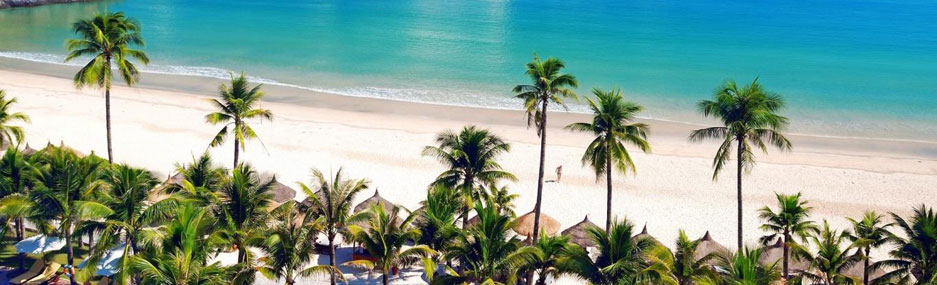
A beach in Vietnam
The Vietnamese territory is divided into three geographical areas: North (Tonkin-Bac Bo), Center (Annam-Trung Bo) and South (Cochin-China-Nam Bo). Currently it is divided into 64 administrative provinces.
The main cities are in Hanoi, the political capital (7.2 million inhabitants in 2014), and Ho Chi Minh City (12.87 million inhabitants in 2014). Other major cities are Haiphong, Danang, Hue, Can Tho.
The Vietnamese territory is crossed by two rivers with densely populated deltas: in the North, the Red River on 510km and its main tributaries, Lo River (Clear River) and River Da (Black River). In the South, the Mekong, after crossing Vietnam for 220km, forms a huge delta, conducive to growing rice.
CLIMATE
With the extension of its latitude, between 8°30 and 23°22, Vietnam offers climatic conditions varying from one region to another. The surroundings of Danang are considered as the climatic boundary. The North has two distinct seasons, marked by an unusual thermal amplitude in the region: winter (from November to April), with temperatures ranging from 20°C to 10°C, and summer, during which the temperature may exceed 35°C. It is not uncommon that at this time typhoons affect the Red River Delta. In the South, the tropical climate is divided into two seasons: rainy season brought by Southwest monsoons (from May to November) and the dry season (from December to April) with a constant temperature of around 27°C. year.
Elephants riding trip.
POPULATION
Overview
Vietnam has approximately 91.3 million inhabitants (February 2015.) The natural increase is 1.054% in 2012, with a strong geographic disparity between regions. The government wants to reduce it through the implementation of a policy of family-friendly. The fertility rate is 2.05 children per woman. Life expectancy at birth is relatively high at 70.85 years.
Density
The average density is 255 inhabitants per km2. The Mekong and Red River deltas are home to 50.8% of the population. The population density is very high, with more than 1000 inhabitants/km2 in the Red River Delta is more than 450 inhabitants/km2 in the Mekong River.
ETHNIC DISTRIBUTION
The country is characterized by its ethnic diversity (54 ethnic groups.) We can say that the Vietnamese population is mainly composed of Viet, officially called Kinh (86%) and 53 ethnic minorities. The latter are found mainly in mountainous regions or highlands: in the northern mountains (30 to 40% of the population) or in the provinces of Cao Bang, Ha Giang, Lang Son, Lai Chau and Son La. Among the ethnic groups, four have more than one million representatives (Tay, Thai, Muong and Khmer,) thirteen have between 100,000 and 900,000 representatives, and 36 have fewer than 100,000. Some have only a few hundred representatives, such as the Braun, about 300.
RELIGIOUS DISTRIBUTION
Vietnamese people practice quite diverse religions: ancestor worship, Taoism, Confucianism, Hinduism, Islam, and Christianity. Buddhism is however dominant (9.3%), followed by Christianity (6.7%), Hoa Hao (1.5%), Caodaism (1.1%), Protestantism (0.5%), Islam (0.1%) and None (80.8%).
LANGUAGE
The official language is Vietnamese, or Kinh. Although borrowing from the Khmer, Thai and Chinese languages, it is written using Latin characters, considered the legacy of European missionaries of the 18th century. French, spoken by about 100,000 people, is experiencing a certain revival today. However, English tends to become the language of business, and is widely taught in schools and training centers.
TRANSPORT
One of the striking and impressive characteristics for foreign tourists coming to Vietnam is that Vietnamese use scooters as the main means of locomotion, compared to cars. Not only in the big cities but also in the countryside that are filled with scooters. Motorcycles allow people to move more easily but also to transport all types of goods such as animals, food, objects ... which makes traffic in the city very dense especially during rush hour. Local residents have adopted unsafe driving which can be dangerous for pedestrians or drivers themselves. To move on a large scale there are trains crisscrossing the country or even buses and air links. In certain regions, such as the Mekong Delta, the privileged transport is the boat.
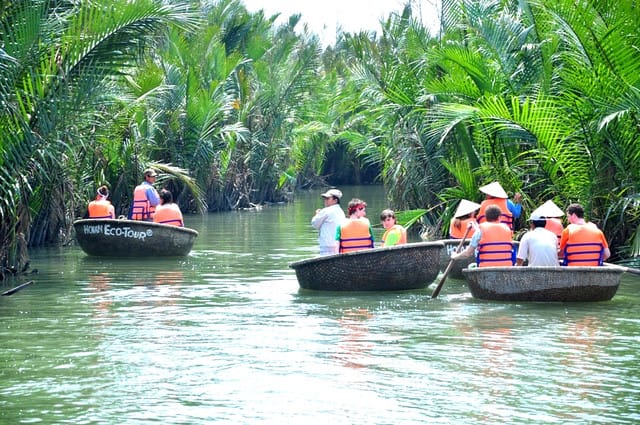
Mekong Delta tours.
AIRPORTS
International airports
As mentioned above, Vietnam has 9 international airports but only 5 of them are currently served by international flights: Tan Son Nhat (in Ho Chi Minh City), Noi Bai (in Hanoi), Cam Ranh (Nha Trang), Danang (in Danang) and Phu Quoc (in Phu Quoc- from 2/12/2012 for international flights).
The remaining four, including domestic flights, include Can Tho (Can Tho), Lien Khuong (Da Lat), Phu Bai (Hue), and Cat Bi (Hai Phong).
National airports
The total number of national airports in Vietnam is 12. These are: Ca Mau (in Ca Mau), Rach Gia (in Kien Giang), Phu Cat (in Binh Dinh), Tuy Hoa (in Phu Yen), Buon Ma Thuot (in Daklak), Pleiku (in Gia Lai), Con Dao (in Ba Ria-Vung Tau), Dong Hoi (in Quang Binh), Chu Lai (in Quang Nam), Vinh (in Nghe An), Tho Xuan (in Thanh Hoa), and Dien Bien Phu (in Dien Bien).
TOURISM
In Vietnam, there is a stark increase in tourism over the years. In 2012, this beautiful country welcomed more than 6,800,000 tourists. In 2014, this number rose to more than 8 million. In order to encourage the arrival of prospective visitors, the Tourism Development Department has put in place new policies with, on the one hand, the development of tourist reception facilities and, on the other hand, a relaxation of the visa policy. From January 1, 2015, tourists from ASEAN member countries, and nationals of 7 countries (Russia, Japan, Korea, Denmark, Norway, Sweden and Finland) may have an exemption visa for a period of 30 days. Until June 30, 2016, the French are exempt from visas for stays of less than 15 days. Sounds perfect for your Vietnam tour, doesn't it ?
Main cities to visit
Hanoi (Hà Nội), the capital of the country, named the city of peace.
Ho Chi Minh City (Saigon), formerly called Saigon, the big, bustling city of the south.
Hue, the imperial city, the Forbidden City in China, a World Heritage Site by UNESCO.
The city of Hoi An, Unesco World Heritage.
Danang with the Cham Temples, remains of the Kingdom of the Champa.
Dalat, the European city.
Nha Trang, famous for its beaches and bay.
Natural sites
There are two remarkable natural sites classified as World Heritage by UNESCO:
Halong Bay
Phong Nha-Ke Bang National Park
Other remaining regions also present magnificent landscapes to discover Mekong Delta, Nha Trang beaches, Phu Quoc Island, sand dunes in Mui Ne, the seabed and coral reefs of Danang or rice terraces in the northern mountains, etc.
Searched by Google:
- Best time to visit vietnam
- Vietnam Tours
- Vietnam Information
- Visiting vietnam in February
- Vietnam weather in February
Travelers talk about us ...
Found this trip organiser on forums/websites and thank to some very good reviews, my friend and I were looking to discover the Vietnamese's
I was referred by a friend to Mr. Ha Nguyen at Vietnam Original Travel - Hanoi Branch and I’m so very very pleased that I was
We pre-booked a short trip around Northern Vietnam with Vietnam Original tours. They responded very quickly to email and were very helpful
And we are recommended